Connecticut DMV Practice Test
View instructions
DMV offices conduct knowledge testing for operator licensing on an appointment basis. The CT DMV written test is based on the information contained in the Connecticut Driver's Manual, including road signs, driving rules, and safety rules. The DMV CT knowledge test consists of 25 questions and you'll need 20 correct answers to pass (80%). You must pass a knowledge test before you receive your learner’s permit. Connecticut requires that you pass a vision test before you get a driver’s license. After you successfully pass the CT DMV practice permit test, you will be able to schedule an appointment for the road test.
Updated for 2026 DMV rules.
1.
A four-way stop sign means:

|
There are four stop signs at this intersection.
|
|
|
Traffic from all four directions must stop.
|
|
|
If two vehicles reach the intersection at the same time, the driver on the left yields to the driver on the right.
|
|
|
All of the above.
|
2.
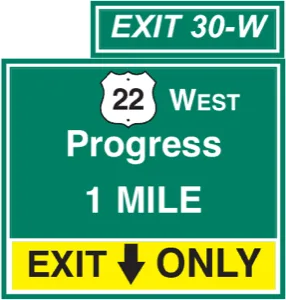
If you see this sign above your lane, you:
|
May not exit the freeway in this lane.
|
|
|
May continue through the interchange or exit the freeway in this lane.
|
|
|
May stay in this lane and continue through the interchange.
|
|
|
Must exit the freeway if you stay in this lane.
|
3.
What is a reversible traffic lane?
|
A lane where the flow of traffic may be reversed by traffic signals.
|
|
|
A lane reserved for car pool vehicles.
|
|
|
A traffic lane where vehicles are allowed to travel in both directions.
|
|
|
A traffic lane where the flow of traffic may change during different times of the day.
|
4.
Drivers should use their high beams at night:
|
When following other vehicles.
|
|
|
Unless oncoming traffic is approaching.
|
|
|
When driving in fog.
|
|
|
Only if it becomes necessary.
|
5.
Drivers should always look carefully for motorcycles before changing lanes because:
|
Motorcycles are smaller and harder to see than cars.
|
|
|
Motorcycles are not permitted to share traffic lanes.
|
|
|
Motorcycles always have the right-of-way at intersections.
|
|
|
All of the above.
|
Next page
Frequently Asked Questions
To obtain a learner’s permit in Connecticut, you must be at least 16 years old. If you are between 16 and 17 years old, after completing a driver training program and keeping the permit for 120 days (or 180 days if you have taken the training at home with a qualified trainer), you can obtain a driver's license. If you are 18 years of age or older, you are required to hold an adult learner’s permit for a minimum of 90 days before obtaining a class D driver's license.
You can schedule your Connecticut knowledge test online. Select dates and times according to the available choices at various Connecticut DMV offices.
Ensure you bring valid documents or certified copies. Here's what you need:
- Proof of Social Security Number (SSN).
- Two proofs of Connecticut residency dated within 90 days. Examples include a bill from a bank, mortgage company, credit card company, hospital…
- A completed application for Non-Commercial Learner's Permit and/or Driver's License.
For under 18 also:
- Completed Certificate of Parental Consent.
For Non-US born also:
- Proof of Legal Presence in the United States.
The DMV written tests are available in various languages, including Arabic, English, French, Italian, Mandarin, Polish, Portuguese, Russian, and Spanish. If your primary language is not among these options, you can bring a dictionary. Anyway, you can’t use a translator during the exam.
The DMV written test is based on the Connecticut Driver Manual. Focus on road signs, safe driving practices and road rules. Take our free practice tests to prepare for the exam, or sign up for DMV Premium to unlock more resources and prepare for your permit test faster!
The Connecticut DMV written test consists of 25 multiple-choice questions and is based on the information provided in the manual. Taking numerous practice tests and thoroughly studying the handbook will increase your chances of success.
In Connecticut, you can miss up to 5 questions on the DMV written test. To pass, you need an accuracy rate of 80% or higher, which means correctly answering at least 20 out of the total 25 questions.
Learner permit holders:
- Cannot drive alone. They must be accompanied by a driving instructor or a driver aged 20 or older with a clean driver record for four consecutive years.
- Cannot use cell phones when driving.
For 16 and 17-year-old drivers, the State of Connecticut imposes these restrictions:
- During the first six months after obtaining a driver's license, you are not allowed to have any passengers in the vehicle, except for a licensed driving instructor, a parent/legal guardian with a valid driver's license, or a driver aged 20 or older with a clean driver record for four consecutive years. During the second six months, you can also transport family members.
- You cannot drive from 11 p.m. to 5 a.m., except in cases of employment, school, religious activities, or medical emergencies.
The passenger and curfew restrictions do not apply if you are a member of a volunteer fire/ambulance company.
A Connecticut instruction permit remains valid until you either obtain a driver's license or for a period of 2 years from the date of issuance, whichever occurs first. This waiting period ensures you have ample time to gain valuable driving experience and feel confident before the exam.
If you do not pass your DMV written test in Connecticut, you will need to wait 7 days before you can retake it. To reschedule an appointment and retake the exam, you have to pay the required fee again.
Don't risk it! Use our Connecticut PDF Cheat Sheet to focus on the road signs and driving laws that matter. We’re so confident you’ll pass that we offer a 100% money-back guarantee.